


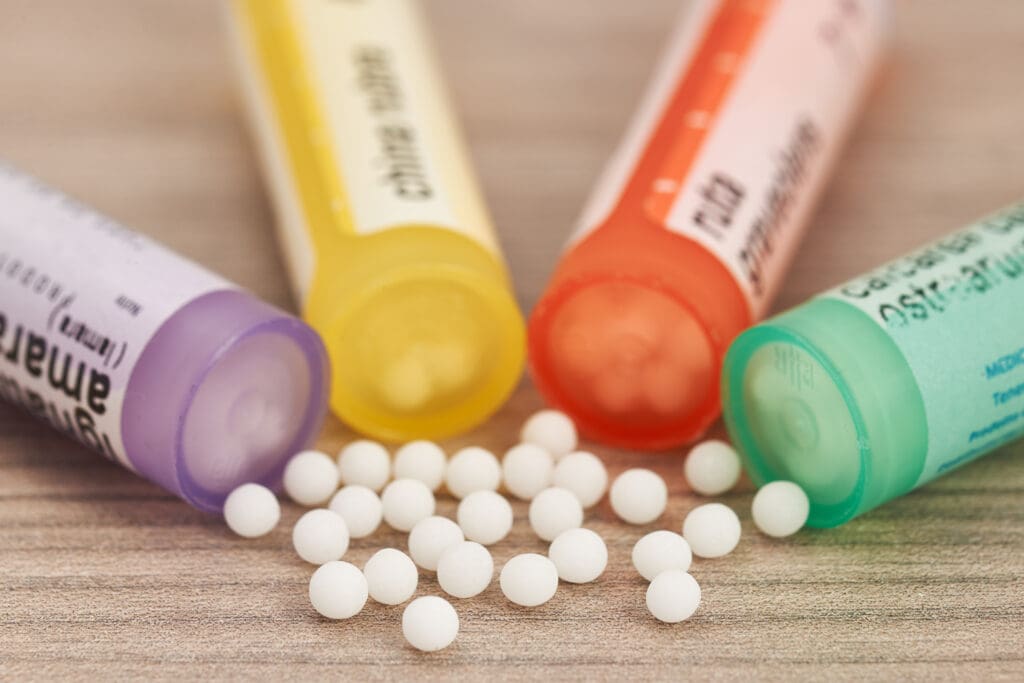
In my early twenties (two decades ago—how is that even possible?), I was deep in the world of natural healing. I’d spend hours wandering health food store aisles, soaking in every herb, tincture, and supplement label like it was sacred text. But there was one shelf I always breezed past: those mysterious little blue Boiron tubes. You know the ones—stacked in neat rows with names I couldn’t pronounce, numbers that made no sense, and tiny labels claiming they could help with anything from grief to gas.
For some reason, I never gave them more than a curious glance. Maybe they felt too… elusive. I could wrap my head around adaptogens and echinacea, but these little sugar pellets? They were still a mystery. Oddly enough, I recently found a dusty old tube of Candida albicans that expired in 2012. I have zero memory of buying it—but apparently I did. Did I try it? Who knows. But oh, how I wish I’d paid more attention back then.
Fast forward about ten years to when I started seeing my first homeopath, who was also a naturopathic doctor. I adored our visits and genuinely felt a shift in my emotional and physical well-being. Unfortunately, she eventually moved out of state and our sessions came to an end.
Recently, I stumbled upon an old email thread between us—and here’s the magical part: I had totally forgotten which remedies she had prescribed, but when I read them again, I realized they’re the exact same ones I’ve recently been called to work with more deeply. Full circle moments like that always leave me a little awe-struck.
After that, homeopathy kind of slipped into the background again. It still felt like a foreign language, and I hadn’t yet learned how to become my own home prescriber. Essential oils were my ride-or-die, and I leaned heavily on them for everything.
Then came 2021 and my pregnancy. That’s when I began learning about cell salts during pregnancy and using homeopathy for labor and postpartum. I treated myself to two beautiful Helios kits, thinking I was prepared. Spoiler alert: I wasn’t. I had the tools, but not the knowledge. And as any first-time mama knows, there’s no manual for those wild, sacred, sleepless days.
I didn’t end up using the remedies the way I wish I had—for labor, for birth, for those raw and tender postpartum moments. Hindsight really is 20/20 (and occasionally brutal).
It wasn’t until I got mastitis—not once, not twice, but five times during my first year of nursing—that homeopathy truly cracked open for me. Nursing was one of the hardest things I’ve ever done (second only to childbirth), and the pain felt relentless. I tried all the natural remedies, but one stood out above the rest: Phytolacca. That little remedy was a game-changer.
Not long after, I found Sepia—and with one dose, it lifted the heavy, gray fog of postpartum depression. It felt like someone opened a window in my soul. (Important side note: there are many remedies that can support PPD, and the right one is always based on your unique symptom picture. I just happened to nail mine with Sepia.)
Those two experiences lit a fire in me. I started bingeing every homeopathy podcast I could find, following every homeopath on Instagram, and building a growing collection of books and remedies. I started treating everything from teething to tummy aches with these gentle, powerful little medicines. Chamomilla and Pulsatilla were teething lifesavers for my son—and I felt safe giving them to him, knowing they were vibrational, diluted, and oh-so-effective.
Eventually, I found the most inspiring homeopath online. I loved how boldly and honestly she spoke. I soaked up every story, every insight. So when she opened enrollment for her two-year Advanced Practitioner Course, my heart said, Yes. This is it.
I wouldn’t have been able to say yes without the support of a dear friend who helped me with tuition—she believed in me even when I wasn’t fully sure I believed in myself. I am forever grateful. This program, and this ancient, beautiful medicine, are changing my life in ways I never expected.
And now, I can’t wait to pass that healing forward—to help others feel lighter, healthier, and more at home in their bodies and minds. This is just the beginning.


